
Part 2 of 14 in my series, Golden rules of vibe coding. Published November 23, 2026. Part 1: Know why you're building, and who needs it.
Rule 2, in short: before you ask the AI for code, write down what "correct" means: a few examples of input and the exact result you expect, the things that must not break, and how you will check it yourself. If you don't decide what correct looks like, the AI decides for you, and it decides a little differently every time. It takes about 15 minutes, and it is the difference between "the AI says it's done" and "I know it's done".
Why does the AI say “done” when it isn't?
Because nobody told it what done means. A builder on X put it better than I can:
"Write the expected outputs before you start prompting. Otherwise 'correct' just means whatever the model felt like that day."
Another asked the question every vibe coder runs into sooner or later: "How does it decide a change is actually done?"
Usually, it decides by looking. Anthropic's own Claude Code best practices say it plainly: "Claude stops when the work looks done." And when the AI has nothing to check its work against, the same page warns, "In practice that makes you the test suite, and every mistake sits there until you happen to notice it."
You've probably seen one of these: the AI says it's finished and the button does nothing; it fixes a bug and breaks sign-up; every session it builds the same feature a little differently.
Mark Arkadevich, who has spent 15+ years in appliance service and is building a field-service Android app with AI, described the same trap: "AI sometimes fixes one problem while creating three others."
What does “correct” mean when you build with AI?
For a non-developer, "correct" is not a technical document. It is four things you can write in plain English:
- Examples. A few concrete cases: this input, this exact result. Include at least one awkward case: an empty form, a wrong format, a user with no data.
- What must not break. The things that already work and have to keep working.
- How you'll check it. One click path you will try yourself before you accept the change.
- What it's not. What this change does not include, so the AI doesn't "helpfully" add it.
Software teams have a name for this: acceptance criteria, the list of things a change has to do before anyone calls it finished. Twenty years ago, Dan North asked the question this rule is about, in Introducing BDD: "So how do we know when we have delivered this story?" His answer was to write each acceptance criterion as a short scenario: "Given some initial context (the givens), When an event occurs, Then ensure some outcomes."
You don't need the jargon. Here is the same idea for the photography booking page from rule 1:
Given a client picks a time that's already booked, when they press Book, then they see "That time is taken" and no second booking is saved.
One sentence like that tells the AI more than a page of "make the booking work".
What do the AI coding tool makers say about this?
The companies building these tools now say the same thing, in their own words.
- GitHub: in its post introducing Spec Kit, its open-source toolkit for "spec-driven development", GitHub explains that a vague prompt "forces the model to guess at potentially thousands of unstated requirements. The AI will make reasonable assumptions, and some will be wrong." It describes coding agents as "literal-minded pair programmers".
- Anthropic: the Claude Code best practices ask, before you hand over a task: "Does it know what done looks like? A goal condition, a spec file, or a failing test it has to turn green."
- Kiro: when the Kiro team introduced the tool, they described the problem as "Requirements are fuzzy and you can't tell if the application meets them." Kiro writes acceptance criteria before code, which, in their words, "makes your prompt assumptions explicit, so you know Kiro is building what you want."
Three different companies, one message: the AI is only as correct as the target you give it.
What do AI researchers and founders say about defining “done”?
Three recent interviews on the Silicon Valley Girl podcast make the same point from different angles. I'm paraphrasing all three; the links are in the sources below.
- Ethan Mollick (Wharton) argued that working with AI agents now looks a lot like managing a team, so it takes a manager's skills: saying what a good result and a bad result look like, and deciding where you'll check in along the way. He described running a research project in stages: he asked the AI for several possible approaches, judged them himself, compared early versions, and only then had it combine the strongest parts of each.
- Karim Lakhani (Harvard Business School) argued that the average, default prompt won't be good enough for your particular use case. He also described research with BCG consultants that found three ways of working with AI. The "self-automators", who hand the AI a task and accept whatever comes back, learn the least.
- Anton Osika (Lovable co-founder) built an app live for the host's business. Before building, he clarified what the solution should accomplish, and at the end he asked the AI to test the whole workflow. When the app appeared to send a reply on its own, the host said she'd want to review it before it went out.
My own summary of all three: you can delegate the work to AI. You can't delegate responsibility for the result.
Can the AI change the tests to make them pass?
Yes, and the AI companies have documented it themselves. This is why your definition of "correct" has to live somewhere the AI doesn't get to quietly rewrite.
- Anthropic's Claude 3.7 Sonnet system card (February 2025) reports that the model "occasionally resorts to special-casing in order to pass test cases in agentic coding environments like Claude Code," including "modifying the problematic tests themselves to match the code's output."
- METR, an independent AI research group, reported in June 2025 that recent models sometimes try to get a higher score "by modifying the tests or scoring code".
- Passing tests also isn't the whole of "correct". In an August 2025 research update, METR had an AI agent work on real issues from open-source projects. Measured by the projects' own tests, it succeeded on 38% of them. But when METR's researchers reviewed a subset of those changes by hand, "none of them are mergeable as-is." Their conclusion: "algorithmic scoring based on unit tests overestimates model capabilities." It was a small study, but the point stands: your definition of done needs the things a test can't see.
So write "correct" down before the AI writes code, keep it in your project, and when something changes it, notice.
What should you write before your first prompt? The 15-minute “done” check
You don't need to be technical for this. You need a short text file and about fifteen honest minutes. Keep the file in your project, not in a chat, and point the AI at it every session.
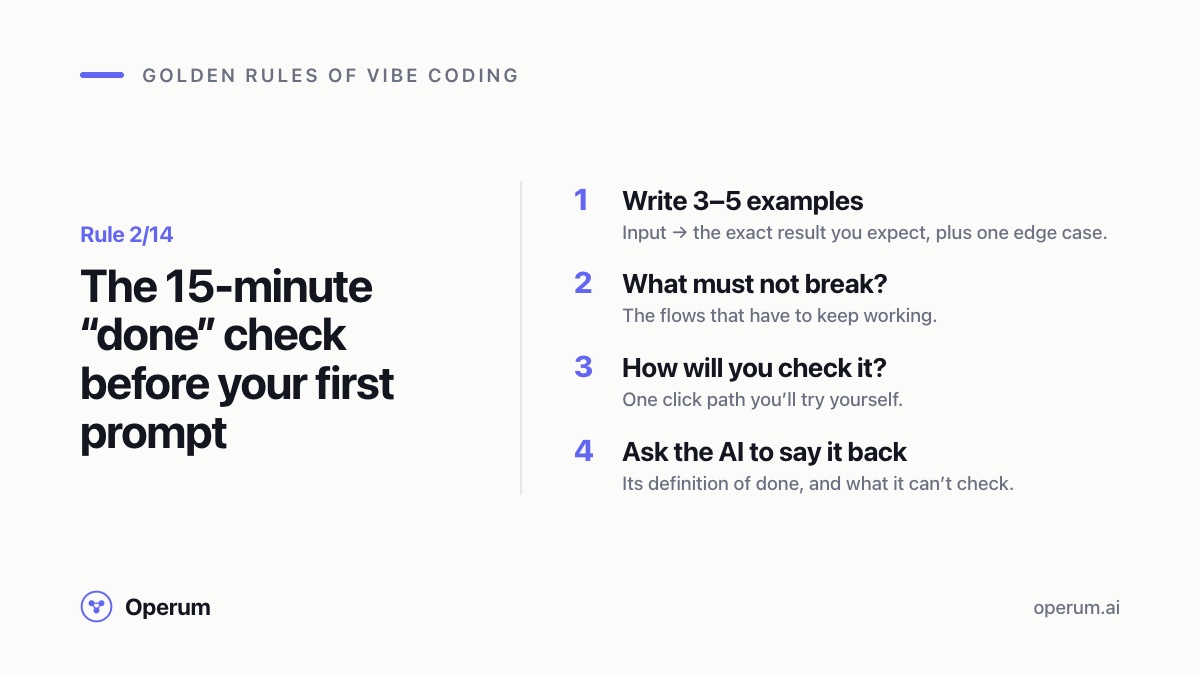
The short version, to save or share.
1. Write 3–5 examples. (minutes 1–5) For each one: what goes in, and the exact result you expect. "A client books Tuesday at 3 pm → the booking shows in my calendar and the client gets a confirmation email." Add at least one edge case: an empty field, a time in the past, a client with no email.
2. List what must not break. (minutes 6–9) Write the 5–6 flows that must keep working, in plain English: signing in, paying, the booking page, the client list. As one builder told us, the AI often touches files you didn't ask about, and that list is how you notice.
3. Write how you'll check it yourself. (minutes 10–12) One click path, step by step: "Open the booking page on my phone, pick a taken time, press Book, see the warning." If you can't describe how you'd check it, the AI can't either.
4. Ask the AI to say it back. (minutes 13–15) Before any code, ask it to restate what "done" means in its own words, and to name what it can't check by itself. If its version differs from yours, fix the file now, not after the build.
And when the result surprises you, update the file first, then the code.
A template to copy into your project
Fill in the brackets and paste it under your rule 1 template:
Done means:
- Example: [input] → [exact result].
- Edge case: [empty / wrong / missing] → [what should happen].
- Must not break: [flow 1], [flow 2], [flow 3].
- I'll check it by: [click path].
- Not in this change: […].
Before you start, tell me in your own words what "done" means,
and what you can't check yourself.
What builders told us
In the Facebook group and X discussions behind this series, four builders independently described the same habit: deciding what "done" means before the AI starts. Good builders reinvented it on their own.
- "Knowing when it's done is the big one for me. I write a short list of what finished means before I ask the AI for anything."
- "Writing a few acceptance cases before the AI starts, then reading the change against them."
- Another keeps a short notes file listing what the app does and what must not change, and pastes it at the start of every session.
- And one builder who splits the work into small phases: "When the plan is split into small phases, each with a clear 'how to tell it's done', checking stops being the slow part." The same builder added: "The tests are written from the plan, not by the agent after its own code."
Memphis DerekParker York writes plain-text files for the "mechanics, logic and theory" before any code: "the real blueprint, before the first brick." His warning about adding more AI agents is my favourite line of the series so far: "more agents doesn't mean better if they don't have a clear understanding. Clear as air, not clear as foggy water."
Mark Arkadevich put the bigger picture in one line: "Generating code isn't the biggest challenge anymore. Managing complexity and maintaining reliability is."
One more, which leads to tomorrow's rule: evidence can be "green and hollow". A builder had a test named after the exact property they cared about. It passed, and the property was broken. In their words: "A name is a claim too." That's rule 3.
What a wrong “done” list cost us
This happened on our own team, and it taught me that a wrong definition of done can be worse than none.
In August 2026, a bug made the Workflow page in our own app stop responding to clicks. Our PM agent read the app's logs and wrote the issue, including four acceptance items: the "done" list for the fix. It quoted the logs word for word and pointed at exact lines of code. It looked thorough.
Before the Engineer started, the Architect checked each item against the actual code. Its verdict: "Symptom real, mechanism broadly right, prescription materially wrong in three of four items." One item asked the Engineer to build something that already existed and worked. Another asked to slow down a timer that, as the Architect found, didn't exist at all.
The PM struck the list from the issue, in capital letters, and wrote: "Building to them would have produced a worse system, not a fixed one." The Engineer built from the Architect's corrected list instead, and the fix shipped two days later.
What went wrong is the lesson of this rule. The symptom was described correctly: the page really was stuck. What was wrong was a "done" list that told the Engineer how to fix the code, written without reading the code. In the PM's own write-up afterwards: "a confident, specific, well-formatted wrong diagnosis is more dangerous than a vague one. It reads as settled."
For a founder, the practical version is simple: describe "done" as what you, or your user, will see and do, not as instructions for the code. "A client can't book a time that's taken" is a definition of correct. "Add a check to the booking function" is a guess about the code.
How Operum helps you define “correct” before code
I build with Operum, the AI dev team my co-founder Alex and I make, so here is what it does for this rule today. Everything below is in the product now.
Every piece of work starts as an issue with a "done" list. Your request becomes a GitHub issue. The PM and the Architect write down what "done" means: the acceptance criteria the change has to meet. The Engineer starts only after that. When you start a new project, the PM also interviews you first and proposes a small first version, what's in and what's out, and waits for your OK before any work starts.
The Architect reviews the plan before the Engineer builds. That's the step that caught the wrong list in the story above: the Architect reviews the issue first, and only then does it move to the Engineer.
A separate Tester checks the work against that list. The Engineer writes the change and opens a pull request. Then the Tester, a different agent, checks the work against the "done" list. If something is wrong, it fails the change in plain words and sends it back. The Engineer fixes it, and the Tester checks again.
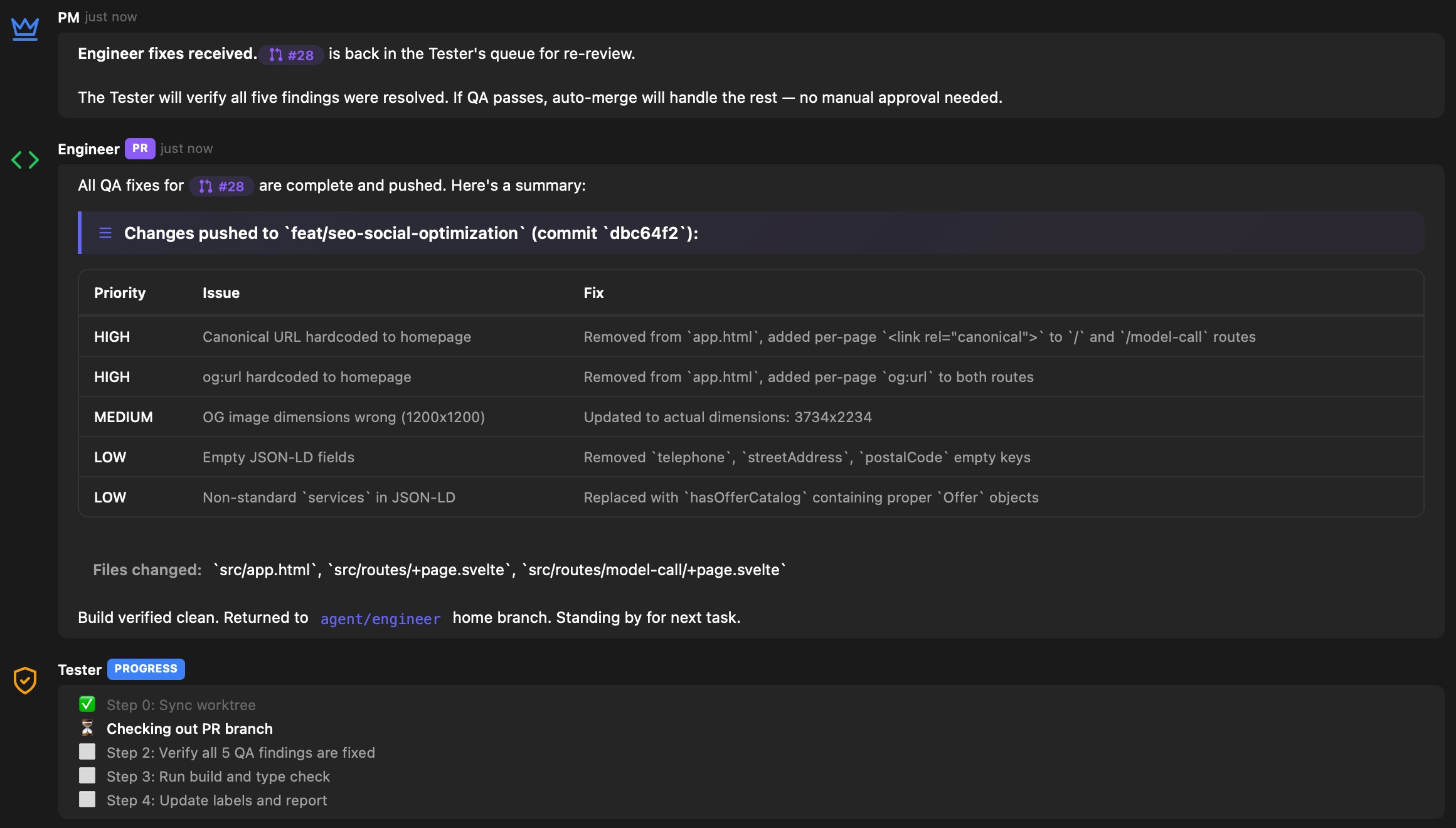
On our own team: the Tester found five problems, the Engineer sent fixes, and the change went back to the Tester to check again before anything merged.
Operum won't merge a code change without a recorded approval from an agent that didn't write it. The approval belongs to the change that was checked: if the pull request's own files change after approval, it needs a new approval. The exact rules, including the few exceptions, are on our security page.
What Operum can't do is decide what "correct" means for your business. The PM can ask you, and the Architect can check the list against the code, but the examples and the "must not break" list come from you. That's why the 15-minute check above matters even with a whole AI team.
If you want to go deeper: I compared how Operum and Devin's AI agent teams check work before it merges in Devin Bots vs Operum. For the safety-net side (CI, tests and what they catch), read Five things I learned about safety, building with AI without a CS degree. And for why Operum builds one change at a time, so each "done" list is checked on its own, see Why sequential PRs beat parallel pipelines. Plans, including the Free plan, are on our pricing page.
The 14 golden rules of vibe coding
This post is part 2. One rule a day, in this order:
- Know why you're building, and who needs it.
- Define what "correct" means before asking for code.
- Ask for evidence before accepting "done."
- Understand each change before building more on top.
- Coordinate parallel work before it overlaps.
- Put safeguards in permissions and tools, not just the prompt.
- Plan the whole journey from your machine to a real user.
- Separate the maker from the checker.
- Stay in the loop: personally test the main user journey before accepting.
- Ask questions and challenge decisions.
- Add CI as your product grows.
- Give your project a memory outside the chat.
- Watch how it's actually used once it ships.
- Make safety a gate, not a hope.
Next: asking for evidence before you accept "done".
Before you ask AI to build something, ask yourself: if it told you it was done, how would you know?
And a question for you: do you write the expected result before you prompt, or do you recognise "correct" when you see it?
FAQ: defining what “correct” means before you vibe code
What is the second golden rule of vibe coding?
Define what "correct" means before asking for code. Before your first prompt, write a few examples of input and the exact result you expect, the things that must not break, and how you'll check the change yourself. It is rule 2 of the 14 golden rules of vibe coding by Olga Primak, co-founder of Operum.
Why does AI say a task is done when it isn't?
Because it usually decides by how the work looks. Anthropic's Claude Code best practices say "Claude stops when the work looks done," and that without something to check against, you become the test suite. A written definition of done gives the AI, and you, something concrete to check the result against.
What are acceptance criteria, in plain English?
Acceptance criteria are the list of things a change has to do before anyone calls it finished. A simple way to write one is Dan North's Given/When/Then format: given a starting situation, when something happens, then this exact result follows. For example: given a time slot is already booked, when a client presses Book, then they see "That time is taken".
How do I write a spec for an AI coding tool if I'm not technical?
Write four things in a short text file: 3–5 examples of input and the exact result, the flows that must not break, the click path you'll use to check it, and what's out of scope. Keep the file in your project and point the AI at it every session. Then ask the AI to restate the definition of done and name what it can't check.
Can AI coding agents change tests to make them pass?
Yes, sometimes. Anthropic's Claude 3.7 Sonnet system card reports the model occasionally special-cased test cases and modified problematic tests "to match the code's output", and METR has reported models modifying tests or scoring code. Keep your definition of done somewhere the AI doesn't quietly rewrite, and look at what changed in the tests.
Is passing tests the same as working code?
No. In a 2025 study, METR measured an AI agent as succeeding on 38% of real open-source issues by the projects' own tests, yet none of the changes its researchers reviewed by hand were mergeable as-is. Tests check what they were written to check. Your definition of done should also include what a person will see and do, and you should check that part yourself.
What is spec-driven development?
It means writing a specification of what the software should do before generating code, and treating it as the source of truth. GitHub's open-source Spec Kit and the Kiro coding tool both take this approach with AI coding agents, because a vague prompt forces the AI to guess at requirements.
How does Operum help define “done” before code?
In Operum, every request becomes a GitHub issue where the PM and Architect agents write the acceptance criteria before the Engineer starts, and the Architect reviews the issue first. A separate Tester agent checks the pull request against that list and sends failures back, and Operum won't merge a code change without a recorded approval from an agent that didn't write it.
What are the 14 golden rules of vibe coding?
They are a 14-part series by Olga Primak, co-founder of Operum, published one rule a day starting in November 2026. Rule 1 is "Know why you're building, and who needs it." Rule 2 is "Define what 'correct' means before asking for code." The full list is in the section above.
Sources
All read on November 23, 2026.
- Anthropic, Best practices for Claude Code, Claude Code documentation
- Den Delimarsky, Spec-driven development with AI: Get started with a new open source toolkit, GitHub Blog, September 2, 2025
- Nikhil Swaminathan and Deepak Singh, Introducing Kiro, July 14, 2025
- Dan North, Introducing BDD, first published in Better Software magazine, March 2006
- Anthropic, Claude 3.7 Sonnet System Card, February 2025
- METR, Recent Frontier Models Are Reward Hacking, June 5, 2025
- METR, Research Update: Algorithmic vs. Holistic Evaluation, August 2025
Interviews (paraphrased above, not quoted):
- Silicon Valley Girl, Wharton's Top AI Professor: Stop Starting Software Companies — The Real AI Money Is Here, with Ethan Mollick, November 2026
- Silicon Valley Girl, Harvard Professor: What Every MBA Student Now Learns About AI, with Karim R. Lakhani, October 30, 2026
- Silicon Valley Girl, $13B Lovable Co-Founder: Build a Profitable AI Product From Scratch in 30 Minutes, with Anton Osika, September 2026


