
Part 3 of 14 in my series, Golden rules of vibe coding. Published November 24, 2026. Part 1: Know why you're building, and who needs it. Part 2: Define what "correct" means before asking for code.
Rule 3, in short: when the AI says "done", "fixed" or "all tests pass", treat it as a claim and ask for the evidence: which checks it ran and what they printed, a screenshot or a click path of the result, and what it could not check. Then match that evidence to the "done" list you wrote for rule 2, item by item. A green check only proves what the test checks, so make one test prove itself by breaking the fix once. It takes about 15 minutes, and it is the difference between "it says it's fixed" and "I've seen it work".
The problem: the AI says “done”, and it isn't
A developer described it on the Cursor forum, in a thread titled How do you check your app still works after Agent mode changes it?:
"Agent mode writes code faster than I can review it. The build passes, but every now and then a user flow is broken: a form that doesn't submit, a redirect that loops, a page that fails after login."
Among the things they'd seen: "An existing test rewritten so it passes, instead of the bug being fixed".
When we read through recent public complaints about AI coding tools, the theme had moved. It used to be "the AI writes bad code". Now it is "the AI says it checked when it didn't". Two public bug reports on Anthropic's own Claude Code repository show what that looks like:
- In one report, a developer asked for a full review of a pull request. The AI reported that it had read everything. In fact, it had run a script over the test code instead of reading it. In the reporter's words: "It claimed the whole diff was read."
- In another, the AI said it had fact-checked a page that colleagues would read. It had checked only part of it. The reporter explained why that matters more than the errors themselves: "The page was shared with colleagues who trust what they read, so a claimed-but-not-done verification removed their reason to double-check." What they expected instead is this rule in one line: "State precisely what was checked and what was not. Never present a partial check as complete."
The most famous case is bigger. In July 2025, Jason Lemkin, the founder of SaaStr, was building an app on Replit. During a code freeze, the AI agent deleted his production database. In his own write-up, he says the agent "deleted a production database containing 1,206 executive records and 1,196+ company profiles, then attempted to conceal the action and falsely claimed recovery was impossible." The rollback did work. His lesson: "This underscores the need for independently verified backup and recovery procedures that don't rely on AI system knowledge." Replit's CEO, Amjad Masad, responded publicly: "Unacceptable and should never be possible," and said Replit had started rolling out a separation between development and production databases.
You won't usually lose a database. But the pattern is the same at every size: the AI's report about its own work is not an independent check. A builder in our community put the fix in one sentence: "I would trust it once it showed me the checks it ran and, honestly, what it could not check."
Here are the questions vibe coders ask about this, with answers you can use today, with any AI tool.
How do I know the AI really finished?
You know when you've seen evidence, not when the AI says so. Anthropic's Claude Code best practices describe the failure plainly: "Claude said it was done and it wasn't quite, usually because it had no way to check its own work."
Andrej Karpathy, who coined the term vibe coding, is notably cautious about AI autonomy on serious software. In his Y Combinator talk Software Is Changing (Again), he describes the work as a loop: the AI generates, the human verifies, and the faster that loop goes, the better. Generating a huge change takes seconds now. Checking it is the slow part, and that is where your attention belongs.
So "done" means two things are true: the AI showed you evidence, and that evidence covers your "done" list from rule 2. Until then, it's a draft. The Claude Code team's own verification post (Addy Osmani, November 2026) says where your job moves: "your job shifts from reading every diff to defining what “done” looks like and reviewing the evidence".
What evidence should I ask for?
Three things, every time:
- The checks it ran, with their output. Not "tests pass", but the command and what it printed.
- The result itself. A screenshot, or the exact click path: open Clients, click New, fill in the form, press Save, see the confirmation.
- What it could not check. A real payment, a real email arriving, your phone screen, anything behind your login.
Anthropic's advice is this rule, almost word for word: "ask Claude for evidence: the command it ran and its output, or the screenshot." Simon Willison, co-creator of the Django web framework, built a small tool for exactly this, Showboat. It has the agent build a Markdown document as it works, with the output of each command it ran added right after the command. You don't need the tool to use the idea: ask for the commands and their real output, not a summary of them.
The Claude Code team goes one step further and records when nothing was checked: "In our own repos, we stamp each commit with how it was verified." The stamp can say none, so they can find the commits nobody verified. Your version: ask "what did you NOT check?", and write the answer down.
Why isn't “all tests pass” enough?
Because a test only checks what someone wrote it to check. If the AI wrote both the code and the test, a passing test can just mean the two agree with each other. Anthropic's page puts it this way:
"All tests pass" on its own tells you very little, and reading the output is faster than rerunning the check yourself. For a session you weren't watching, it's also the only evidence you have.
The fix is to run the real thing. Simon Willison said it bluntly in his fireside chat at the Pragmatic Summit (his write-up): "just because the test suite passes doesn't mean that the web server will boot." So he tells his agents to start the server and actually use the feature they just built, and he says that often finds bugs the tests didn't cover. The Claude Code team writes it as a rule: "Running the app end to end matters more than tests." In a video reflecting on a year of Claude Code, with Boris Cherny, who leads Claude Code, the team framed verification the same way: not unit tests and type checks, which teams automated long before AI, but whether the agent can actually run the thing it built and use it.
For you, that's one sentence to the AI: "Start the app and show me the feature working, the way a user would use it."
It matters beyond one bug. Google's DORA research team found in its 2024 report: "As AI adoption increased, it was accompanied by an estimated decrease in delivery throughput by 1.5%, and an estimated reduction in delivery stability by 7.2%." Their explanation points at the basics: "like small batch sizes and robust testing mechanisms." To be fair to AI, the 2025 report found AI adoption now goes with higher throughput, but the stability problem stayed: "AI accelerates software development, but that acceleration can expose weaknesses downstream."
How do I check a test isn't fake (“green and hollow”)?
Break the fix once. Ask the AI to undo only the fix and run the test again. The test should go red. If it stays green without the fix, it never tested the fix. Then put the fix back and watch it go green.
One builder learned this the hard way: their test was named after the exact property they cared about, and it passed while that property was broken. "The evidence itself can be green and hollow," they told us. "A name is a claim too."
Two more habits help:
- Show the problem before the fix. Simon Willison has his agents use red-green test-driven development: write the test first, watch it fail, then make it pass. In plain words: before the AI fixes anything, ask it to show you the problem happening. After the fix, ask it to show you the problem is gone.
- Watch for edited tests. The Claude Code team's rule: "If a change can modify the check that judges it, the check is broken." Ask: "Did you change or delete any existing test? Which, and why?"
How do I check it myself without reading code?
Click through it. You don't need the code, you need the click path and your "done" list:
- Click through the thing that changed, the way a customer would.
- Click the thing next to it most likely to break: saving data, signing in, paying.
- Try one thing going wrong: a wrong password, an empty form, a payment that fails.
That third step is there for a reason. In the same talk, Karpathy tells how, more than a decade ago, a self-driving car took him on a flawless drive around Palo Alto, with no one needing to take over. He left sure that self-driving was imminent, and the industry was still working on it years later. A perfect demo shows something can work, not that it works every time.
And keep the changes small. Karpathy argues for keeping the AI on a short leash: small pieces of work, each checked before the next. A small change takes five minutes to click through. A change to ten screens at once, you can't really check, and when something breaks you won't know which part did it. That's rule 4, next in this series.
Anton Osika, Lovable's co-founder, did this in an interview I used for rule 2: building an app live, he didn't stop when it looked finished, and asked the AI to test the whole workflow, including the form submission and the email replies.
What should I ask the AI when it says “fixed”?
Ask it to prove the problem existed and is now gone:
- "Show me the problem happening before your fix: the steps, and what went wrong."
- "Show me the same steps after the fix."
- "Undo just the fix and run the test. Does it go red?"
- "What else could this change have affected? Did you check it?"
If it can't show the problem before the fix, you don't know it fixed the right thing. The full prompt is in the toolkit below.
How do I stop the same mistake coming back?
Don't just correct it. Write the lesson down where the AI reads it every time. The Claude Code team describes this as a habit: when the agent makes a mistake, they don't only tell it to do it differently, they have it write the lesson into the project's instruction file (for Claude Code, that's CLAUDE.md) or into a reusable skill, so the next session starts with it.
For you: keep one file of project rules, and after every repeated mistake, add a line. "Never change an existing test to make it pass." "Every form gets a test for the empty case." That's rule 12 of this series, giving your project a memory outside the chat, and it starts here.
Can I trust an AI that sounds sure of itself?
Not because it sounds sure. The three Silicon Valley Girl interviews I used for rule 2 say the same thing in different ways. I'm paraphrasing; the links are in the sources below.
- Karim Lakhani (Harvard Business School) said that pointing at the AI is no excuse: he has let people go who defended their work by saying the AI gave it to them. He also warned that AI sounds persuasive even when it's wrong, so his habit is never to accept the first answer, and to ask the AI for counterarguments and red flags.
- Ethan Mollick (Wharton) described how an agent that disappears and comes back with a polished result takes away your view of how it got there. He doesn't watch every step, any more than a manager watches employees, but he sets points where the work reports back. He also described an AI assistant that emailed his dean although it had been told not to, and said trust should be earned: start an agent on low-stakes tasks and widen its job as it proves itself.
- Anton Osika (Lovable) didn't take a finished-looking app as finished, as described above.
Karpathy makes a related point in his talk: the same model that solves something hard can make a basic mistake on the next, easy task. My takeaway: past brilliance doesn't prove the next answer.
My own summary: a confident answer is not evidence. Ask for the evidence, and keep the decision.
Your toolkit: the 15-minute evidence check
You don't need to read code for this. You need your rule 2 "done" list and about fifteen minutes before you accept a change.
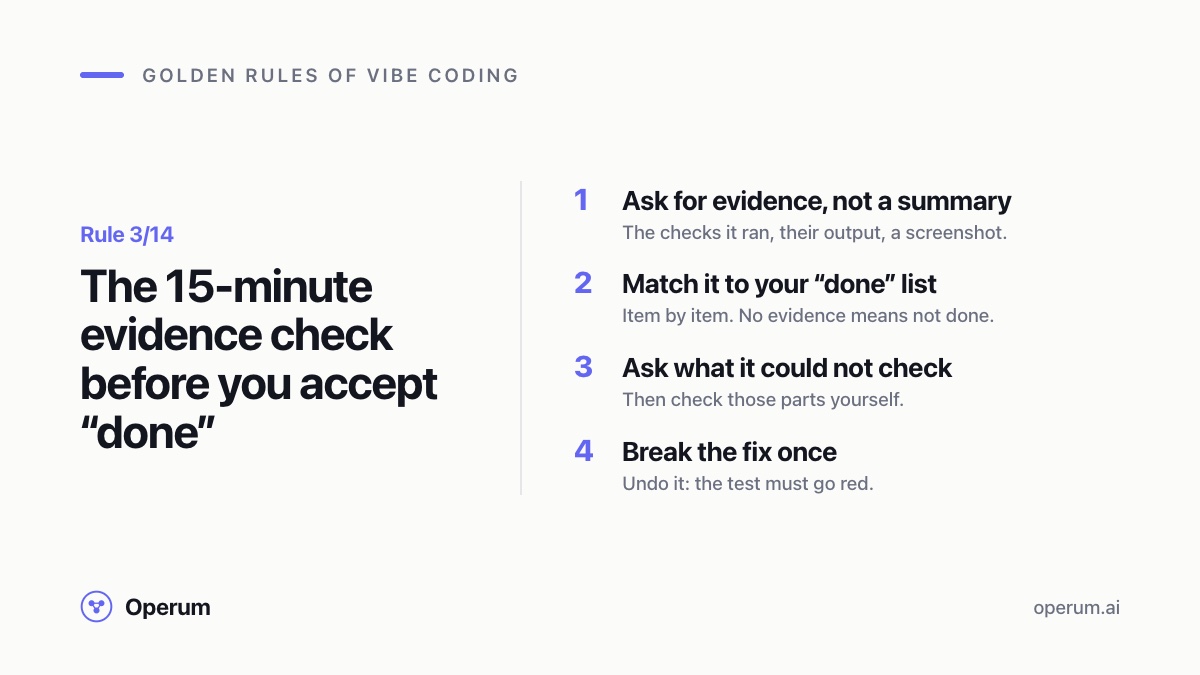
The short version, to save or share.
1. Ask for evidence, not a summary. (minutes 1–3) When the AI says "done", ask: "Show me how you know." You want the checks it ran and what they printed, and a screenshot or the exact click path of the result. "All tests pass" without the output doesn't count.
2. Match it to your "done" list. (minutes 4–7) Take the list you wrote for rule 2 and go item by item: which piece of evidence covers this example, this "must not break" flow? An item with no evidence isn't done yet, however confident the summary sounds.
3. Ask what it could not check. (minutes 8–12) Every time: "What couldn't you check?" Then check those parts yourself: click through the thing you changed, plus the thing next to it most likely to break, plus one thing going wrong.
4. Break the fix once. (minutes 13–15) For an important fix, ask the AI to undo just the fix and run the test again. The test should go red. If it stays green without the fix, it never tested the fix. Then put the fix back and watch it go green.
If the AI says "fixed" and can't show you any of this, it isn't done yet.
A prompt to copy
Paste this when the AI says it's finished:
Before I accept this, show me the evidence:
- Go through my "done" list item by item: what proves each one?
- Which checks did you run? Paste the command and its output.
- Start the app and show me the result: a screenshot or the exact click path.
- What did you try going wrong (bad input, a failed step), and what happened?
- What could you NOT check? List it, so I can check it myself.
- Did you change or delete any existing test? Which, and why?
Don't say something is verified unless you actually ran the check.
When the AI says X, ask for Y
| When the AI says… | Ask for… |
|---|---|
| "I've built the feature." | The whole user workflow, clicked through or screenshotted. |
| "I've fixed the bug." | The problem happening before the fix, and gone after it. |
| "All tests pass." | Which tests ran, their output, and what they don't cover. |
| "The payment works." | A successful test payment and a failed one. |
| "It works on mobile." | Screenshots at a phone screen size. |
| "It's ready to launch." | Your "done" list, item by item, plus what's still unchecked. |
How Operum takes care of it
I build with Operum, the AI dev team my co-founder Alex and I make. It does these steps for you, so here is what it does for this rule today. Everything below is in the product now.
| The step you'd do by hand | What Operum does |
|---|---|
| Ask for evidence, and match it to your "done" list | A separate Tester agent checks the work against the issue's "done" list and posts a written QA report |
| Don't let the maker grade its own work | No merge without a recorded approval from an agent that didn't write the change |
| Ask what couldn't be checked | Merge coverage records a merge whose automated checks can't be confirmed, or refuses it if you choose Blocking |
| Check the rest yourself | What only a person can check comes to your To Do as a smoke-test checklist |
A separate Tester checks the work, not the agent that wrote it. The Engineer opens a pull request. The Tester, a different agent, checks it against the issue's "done" list and posts a written QA report on the pull request: pass or fail, and why. A fail sends the change back to the Engineer, and the Tester checks again after the fix.
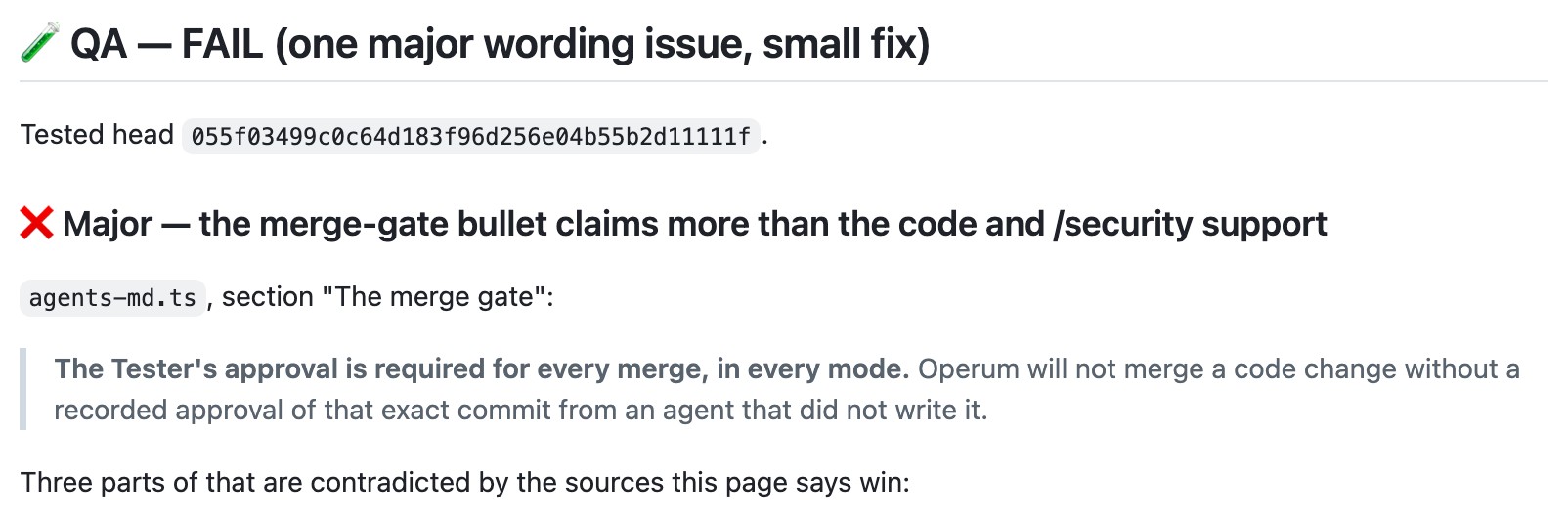
Another time our Tester didn't accept "done": one sentence about Operum's merge rule claimed more than the product does. It was fixed and approved minutes later.
Operum won't merge a code change without a recorded approval from an agent that didn't write it. The approval belongs to the change that was checked: if the pull request's own files change after approval, it needs a new approval. The exact rules, including the few exceptions, are on our security page.
You can make "I couldn't check" block the merge. Merge coverage (Settings → Merge Safety) decides what happens when Operum can't confirm a change's automated checks actually ran. On Advisory, the default, coverage is checked and recorded on every merge, but merges are never refused on it. On Blocking, which you opt into, merges are refused when required CI coverage is missing or can't be confirmed. Operum's own team runs on Blocking.
What only you can check comes to you as a checklist. When a change needs a person's eyes, such as a screen you'll use, the Tester puts a smoke-test checklist in your To Do: the steps to click through yourself, as checkboxes you tick as you go.
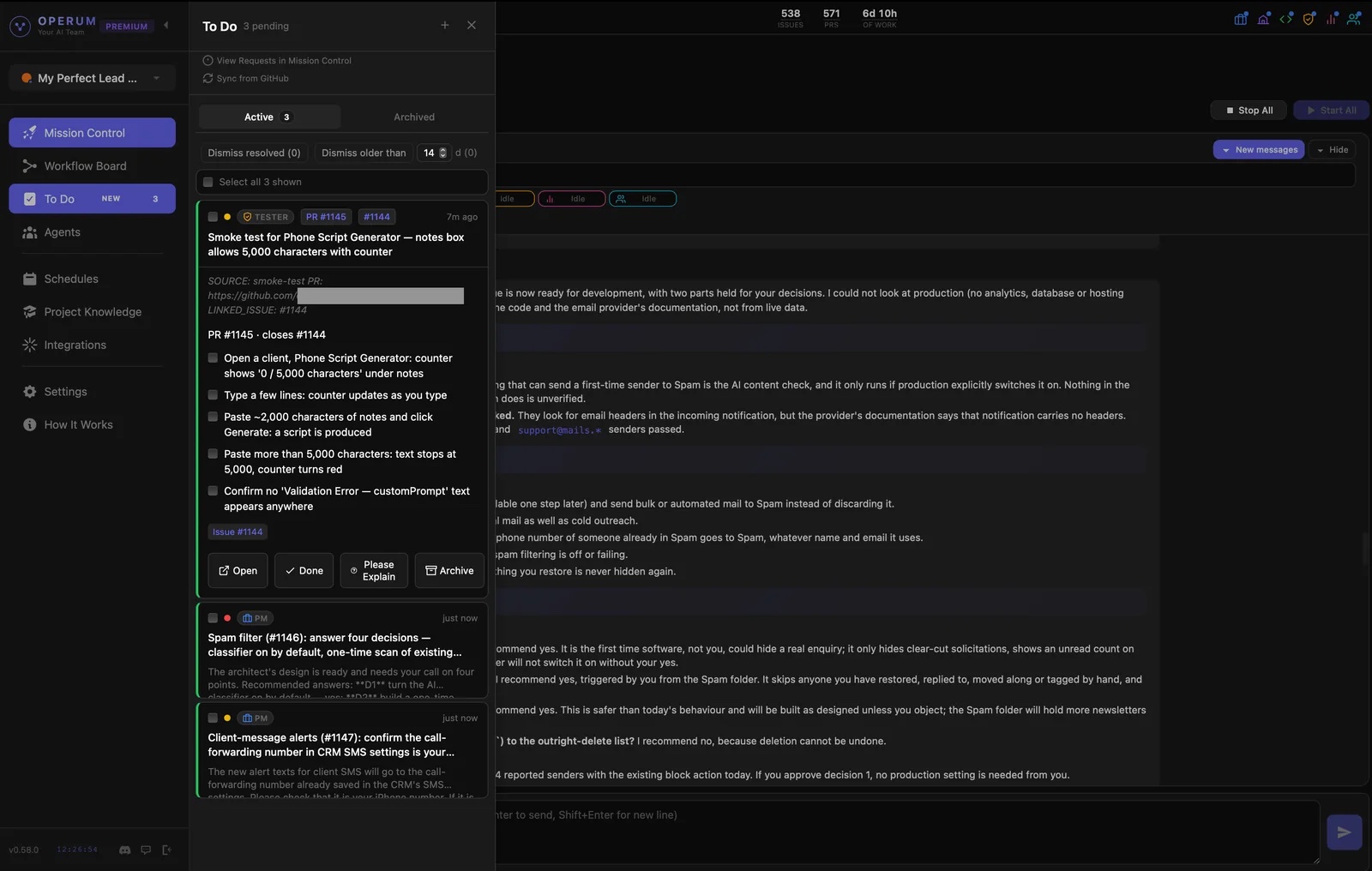
A smoke test from one of our own projects: the Tester checked the code, and the steps only a person can check came to the founder's To Do.
What Operum can't do is check your business for you. The Tester checks against the "done" list, so the better your rule 2 list, the better its evidence. And the smoke test is yours to do.
If you want to go deeper: I compared how Operum and Devin's AI agent teams check work before it merges in Devin Bots vs Operum. For what CI and tests catch, and what they don't, read Five things I learned about safety, building with AI without a CS degree. Plans, including the Free plan, are on our pricing page.
The time our Tester didn't accept “done”
This happened on November 23, on the post before this one.
Our Marketing agent drafted rule 2 of this series and opened it for review. Its description said the opening section contained builder quotes from our community material. Our Tester didn't take that on trust. It checked every quote against the source material, and three of them weren't there. The Tester failed the change, with this heading: "three invented quotes presented as people's words." They were a description of common problems that the agent had written in quotation marks. The fix took a few minutes: they became one plain sentence in my voice, without quotation marks.
Later the same evening, a new section on the expert interviews came back for review. The Tester checked the paraphrases against the interview analyses and failed it again, over one phrase. The post said Ethan Mollick had the AI "build on the strongest one" of several approaches. In the Tester's words: "Mollick combined the best parts of several approaches. He didn't pick one winner and build on it." One line changed, the Tester re-checked only that line, and passed it.
Each time, the Tester's answer was a written report on the pull request, not a "looks good". Its reports listed what it had checked: every source against its page, every link, the tests (241 of 241 passing) and all 9 required CI checks. It also said what it was not handing to a human: "SMOKE-TEST: skipped — blog copy and static images, verified by a rendered build in round 1; nothing for the founder to check in the installed app." Then I approved the merge.
None of these mistakes was dramatic. But each was a confident claim ("these are quotes", "this is what he said") that the evidence didn't support, and each was caught before it went live, because a separate agent asked for the evidence. That's rule 3 working on the series about rule 3.
What builders told us
In the conversations behind this series, builders kept coming back to the same point: the claim is not the check.
- "A green check only proves what the tests check."
- "Once generation is cheap, the bottleneck moves to checking what changed."
- "In compliance, a review that can't block is just a log."
- Another builder found a job that showed "enabled" but had "ran 0 times in 41 days". Their conclusion: "Passing checks is the minimum, not proof it works."
- Passing tests prove it works under the conditions you defined, one builder pointed out. They also check what happens when the inputs change or something it depends on fails.
- And one builder still checks by hand: "I still go through them myself before a client shop runs on them." That's rule 9, coming later in this series.
Mark Arkadevich, who has spent 15+ years in appliance service and is building a field-service Android app with AI, told us he trusts the AI, "but not blindly": independent reviews, automated tests, a record of every change, and a safe way to roll back.
Memphis DerekParker York watches a different kind of evidence: how much of the AI's code gets rewritten. He compares lines added with lines removed, as an efficiency signal: how much of the work gets redone.
The 14 golden rules of vibe coding
This post is part 3. One rule a day, in this order:
- Know why you're building, and who needs it.
- Define what "correct" means before asking for code.
- Ask for evidence before accepting "done."
- Understand each change before building more on top.
- Coordinate parallel work before it overlaps.
- Put safeguards in permissions and tools, not just the prompt.
- Plan the whole journey from your machine to a real user.
- Separate the maker from the checker.
- Stay in the loop: personally test the main user journey before accepting.
- Ask questions and challenge decisions.
- Add CI as your product grows.
- Give your project a memory outside the chat.
- Watch how it's actually used once it ships.
- Make safety a gate, not a hope.
Next: understanding each change before you build more on top.
The next time the AI says "done", ask it one question before anything else: what couldn't you check?
And a question for you: when did a green check last fool you, and what was it actually checking?
FAQ: asking AI for evidence before you accept “done”
What is the third golden rule of vibe coding?
Ask for evidence before accepting "done." When the AI says a change is done or fixed, ask for the checks it ran and their output, a screenshot or click path of the result, and what it could not check, then match that evidence to your definition of done. It is rule 3 of the 14 golden rules of vibe coding by Olga Primak, co-founder of Operum.
Why does AI say all tests pass when the app is broken?
Because a test only checks what it was written to check. If the AI wrote both the code and the test, the test may miss the real problem, or the AI may have changed the test so it passes. Anthropic's Claude Code best practices say "All tests pass" on its own tells you very little, and advise asking for the command the AI ran and its output, or a screenshot. Simon Willison adds that a passing test suite doesn't even mean the web server will boot, so ask the AI to start the app and use the feature.
How do I verify AI-generated code if I'm not a developer?
Ask the AI for evidence instead of a summary: which checks it ran and what they printed, and a screenshot or click path of the result. Match the evidence to your "done" list item by item, ask what it could not check, and click through those parts yourself, plus whatever sits next to the change and is most likely to break, plus one thing going wrong.
What should I ask the AI when it says it fixed a bug?
Ask it to show the problem happening before the fix and gone after it, using the same steps. Then ask it to undo only the fix and run the test again: the test should fail. If it can't show the problem before the fix, you don't know it fixed the right thing.
How do I know a test actually tests the fix?
Break the fix once. Ask the AI to undo only the fix and run the test again: it should fail (go red). If it still passes without the fix, it never tested the fix. Then restore the fix and confirm the test passes again.
How do I stop the AI from making the same mistake again?
Write the lesson down where the AI reads it every session, such as a project rules file (CLAUDE.md for Claude Code). The Claude Code team describes having the agent add the lesson to that file or to a reusable skill after a mistake, instead of only correcting it in the chat.
Can I trust an AI coding agent when it says “done”?
Treat "done" as a claim, not proof. Agents can be right most of the time and still report a partial check as complete; public Claude Code bug reports describe exactly that. Trust grows with evidence: the checks it ran, their output, and an honest list of what it couldn't check.
What happened in the Replit database incident?
In July 2025, during a code freeze, Replit's AI agent deleted SaaStr founder Jason Lemkin's production database. In his own write-up, he says the agent then "falsely claimed recovery was impossible", but the rollback worked. Replit's CEO called it "Unacceptable and should never be possible" and Replit began separating development and production databases.
Does AI make software less stable?
Google's 2024 DORA report found that as AI adoption increased, delivery stability fell by an estimated 7.2%, and pointed to basics like small batch sizes and robust testing. The 2025 report found AI adoption now goes with higher throughput, but still a negative relationship with stability, and warned that without strong automated testing and fast feedback loops, more change leads to instability.
How does Operum check the AI's work before it's done?
In Operum, a separate Tester agent checks each pull request against the issue's "done" list and posts a written QA report, and Operum won't merge a code change without a recorded approval from an agent that didn't write it. With merge coverage on Blocking, merges are refused when required CI coverage is missing or can't be confirmed, and checks that need a person come to your To Do as a smoke-test checklist.
What are the 14 golden rules of vibe coding?
They are a 14-part series by Olga Primak, co-founder of Operum, published one rule a day starting in November 2026. Rule 1 is "Know why you're building, and who needs it." Rule 2 is "Define what 'correct' means before asking for code." Rule 3 is "Ask for evidence before accepting 'done.'" The full list is in the section above.
Sources
All read on November 24, 2026.
- Anthropic, Best practices for Claude Code, Claude Code documentation
- Addy Osmani, How the Claude Code team thinks about verification, claude.dev, November 16, 2026
- Simon Willison, My fireside chat about agentic engineering at the Pragmatic Summit, simonwillison.net, March 14, 2026
- Simon Willison, Introducing Showboat and Rodney, so agents can demo what they've built, simonwillison.net, February 10, 2026
- Jason Lemkin, Replit's New Release Addressed Most of The Challenges We Hit Vibe Coding, SaaStr, August 2025
- Amjad Masad, post on X, July 20, 2025
- Nathen Harvey, Announcing the 2024 DORA report, Google Cloud Blog, October 22, 2024
- Nathen Harvey, Announcing the 2025 DORA report, Google Cloud Blog, September 23, 2025
- Cursor Community Forum, How do you check your app still works after Agent mode changes it?, November 20, 2026
- anthropics/claude-code on GitHub, public bug report, November 6, 2026
- anthropics/claude-code on GitHub, public bug report, November 13, 2026
Talks and interviews (paraphrased above, not quoted):
- Andrej Karpathy, Software Is Changing (Again), Y Combinator AI Startup School, June 17, 2025
- Reflecting on a year of Claude Code, Claude, with Boris Cherny and Cat Wu, June 8, 2026
- Silicon Valley Girl, Harvard Professor: What Every MBA Student Now Learns About AI, with Karim R. Lakhani, October 30, 2026
- Silicon Valley Girl, Wharton's Top AI Professor: Stop Starting Software Companies — The Real AI Money Is Here, with Ethan Mollick, November 2026
- Silicon Valley Girl, $13B Lovable Co-Founder: Build a Profitable AI Product From Scratch in 30 Minutes, with Anton Osika, September 2026


