
Part 4 of 14 in my series, Golden rules of vibe coding. Published November 25, 2026. Part 1: Know why you're building, and who needs it. Part 2: Define what "correct" means before asking for code. Part 3: Ask for evidence before accepting "done".
Rule 4, in short: you don't need to understand every line your AI writes. But you should understand every decision you're accepting. Before you build the next thing on top of a change, make sure you can answer four questions about it in plain words: what exactly changed, why it was needed, what else it could affect, and how you know it works. If you can't explain it back, don't build on it yet. Keep each change small, so there is one thing to understand, one thing to check and one thing to undo.
The problem: every change you accept becomes the foundation for the next one
In February 2025, Andrej Karpathy named the way many of us now build. In the post that coined vibe coding (quoted in full by Simon Willison), he wrote:
I "Accept All" always, I don't read the diffs anymore.
To be fair to him, he also said where it belongs: "It's not too bad for throwaway weekend projects, but still quite amusing." And he named the cost in the same post: "The code grows beyond my usual comprehension, I'd have to really read through it for a while."
For a weekend project, that's fine. For something customers use, it isn't, and the reason is simple: every change you accept becomes the ground the next change stands on. If the first one carries a wrong assumption, the AI builds the second on top of it, then the third. By the time something looks wrong, the cause is several changes down, and nobody remembers agreeing to it.
That's how one fix turns into three new problems. Often the first problem was never really understood, so each fix lands on a guess.
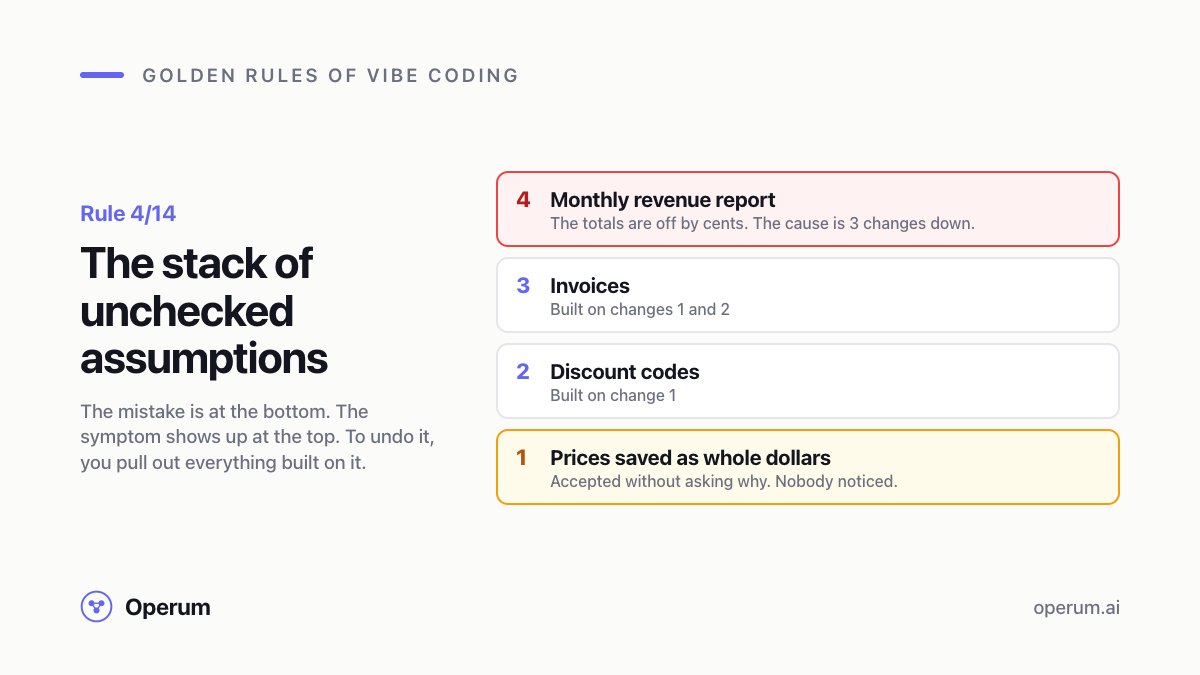
An illustration, not a real project: the mistake sits at the bottom, and the symptom shows up three changes later.
Addy Osmani put the economics in one line in Agentic Code Review (June 2026): "We made writing cheap, and understanding stayed exactly as expensive as it has always been." He also described what happens next on teams: "Reviewers simply could not keep pace with the volume, so code began merging unread, and that became normal."
Here are the questions vibe coders ask about this, with answers you can use today, with any AI tool.
How is this different from asking for evidence (rule 3)?
Rule 3 asks: does it work? Rule 4 asks: what did I just accept, and what am I now assuming?
A change can pass every check and still carry a decision you would never have made. In the illustration above, storing prices as whole dollars works perfectly for a $50 product. The tests pass, the screenshot looks right, and the evidence from rule 3 is real. The decision is still wrong for your business, and nothing in "it works" tells you so. Only understanding what changed does.
So the two rules work together. Evidence tells you the change does what it says. Understanding tells you what it says is what you wanted, and what it quietly decided for you along the way.
Do I need to read every line of code the AI writes?
No. Addy Osmani makes exactly this point in The Code Nobody Reads (September 2026): "Reading every line was never what made software trustworthy." His test is whether you can explain the change: "You don't need to have read every line, but you should be able to explain what the change does," what it touches and why it's safe to ship. And then the line I keep coming back to:
"You can only really be accountable for what you can explain."
In January, in Code Review in the Age of AI, he wrote the developer version: "Never commit code you can't explain." The version for the rest of us: never approve a change whose consequences you can't explain.
That's what this rule asks of you. Not to become a programmer. To understand the decisions.
What does it mean to understand a change if I'm not a developer?
It means you can answer four questions about it in your own words. The AI can help you answer them; it can't answer them for you.
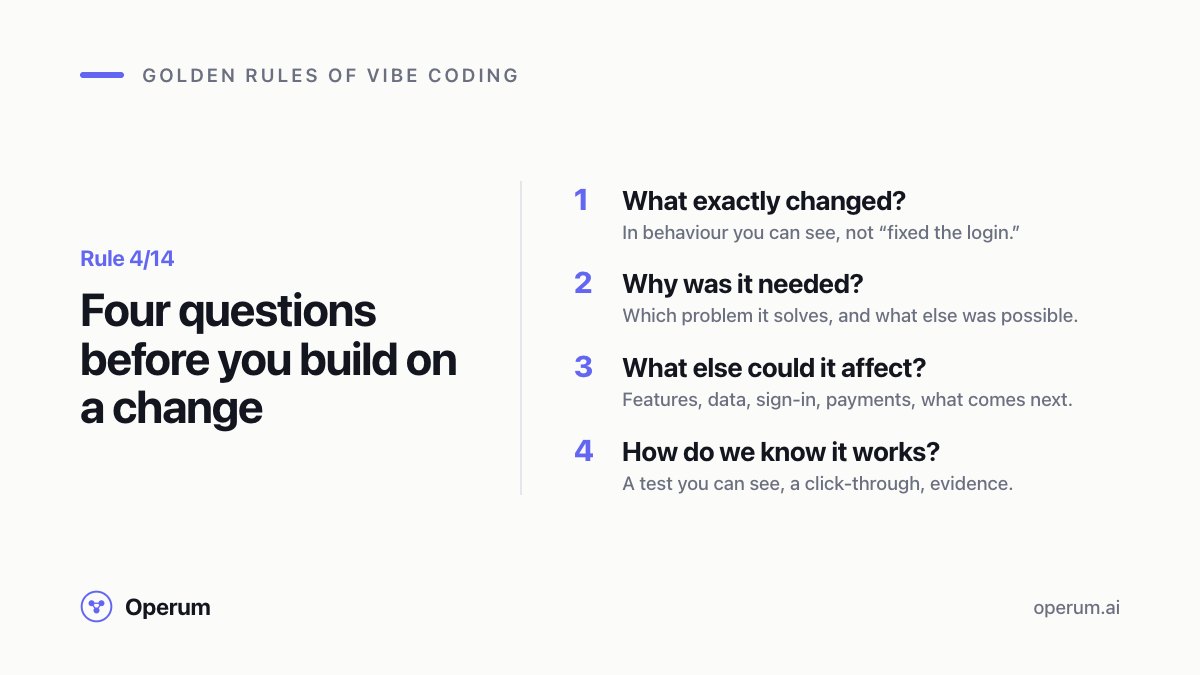
The four questions, to save or share.
- What exactly changed? In behavior and in parts of the product, not "fixed the login". For example: "Sign-in now keeps you logged in for 30 days instead of 1, and this applies to every user, including admins."
- Why was it needed? Which problem it solves, and what else could have been done. If the answer is "you asked me to", ask what the alternatives were and why it picked this one.
- What else could it affect? Existing features, the data your users already saved, sign-in, payments, anything connected to another service, and the next thing you plan to build.
- How do we know it works? A test you can see, a click-through, a screenshot. That's rule 3.
Osmani's checklist for a pull request starts the same way: "What/why: Intent in 1-2 sentences." And he adds: "If you can't fill this out, you don't understand your own change well enough to ask someone else to approve it." GitHub's guide to reviewing AI-generated code asks the second question in its own words: "Does this code solve the right problem? Does it follow our conventions?" And it warns: "Be skeptical of code that “looks right” but doesn't match your intent."
Why does a small wrong assumption become so expensive?
Because the AI copies what's already there. Simon Willison, co-creator of the Django web framework, said it at the Pragmatic Summit (his write-up): "If you've got a codebase with a bunch of patterns in, they will follow those patterns almost to a tee."
That's good news when the patterns are good. It's bad news for the shortcut you didn't notice. The AI doesn't treat change 1 as a mistake. It treats it as the way your project does things, and repeats it in change 2, 3 and 4. A small wrong assumption becomes a pattern, and a pattern takes much longer to undo than one change.
Willison is blunt about who owns that: "Having poor quality code from an agent is a choice that you make. If the agent spits out 2,000 lines of bad code and you choose to ignore it, that's on you."
How big should each change be?
Small enough that you can answer the four questions in a couple of minutes. Osmani's rule for developers: "Break work into small pieces - easier for AI to produce and for humans to review." And: "Small commits with clear messages serve as checkpoints." Willison's list of things to avoid says the same: "Several small PRs beats one big one" (Anti-patterns).
For you, that means:
- One change at a time, each saved as its own version (a commit), so there is always exactly one thing to undo.
- Short sessions. The longer a session runs, the more changes pile up before you look at any of them. One builder's reason for keeping them short is below.
- If a fix needs a third attempt in one session, stop. Go back to the last version that worked, and start the fix again from there with what you've learned, instead of asking for a fix on top of a fix on top of a fix.
Can I trust the AI's own summary of what it changed?
Read it, but don't stop there. Willison's warning applies to everyone: "Agents write convincing looking pull request descriptions. You need to review these too!"
Two simple checks:
- Ask for the list of files it touched, and compare it with what you asked for. If you asked for a new button on the booking page and it also changed the payment code, that's your first question.
- Ask what it didn't check, or isn't sure about. Osmani's advice for reviewers works for founders too: "Be honest about what you didn't review." An AI that names its own gaps is easier to trust than one that summarizes everything as done.
How much checking does each change need?
Not the same amount for every change. Osmani's rule: "Tier by risk, not by author." In his words, "How much review a change needs depends almost entirely on its blast radius", and "A config change earns a linter and a glance."
In plain terms:
- A color, a label, a typo: a quick look is enough.
- Anything touching sign-in, payments, user data or something users rely on every day: the four questions, every time, and the "must not change" list below.
He also warns against the opposite mistake: "do not wave through a big change because the tests are green."
Your toolkit: the 15-minute understanding check
You don't need to read code for this. You need about fifteen minutes before you accept a change and build the next thing on it.
1. Ask for the change in plain words. (minutes 1–4) Before you accept anything, ask: "Explain what you changed as if I were a customer: what will I see differently? Which files did you touch?" Then compare the files with what you asked for.
2. Ask why, and what else was possible. (minutes 5–7) "Why this approach? What were the alternatives? What did you decide on my behalf that I should know about?" Decisions you didn't know about are exactly the ones that get built on.
3. Check it against your "must not change" list. (minutes 8–12) Keep a short file of what must stay true: prices include tax, every user sees only their own clients, sign-in works on a phone. Ask: "Could this change affect anything on this list?" Then check those items yourself, the way rule 3 describes.
4. Explain it back, and write one line in your change diary. (minutes 13–15) Say what changed and why in one or two sentences. If you can't, don't build on it yet: ask again, or undo it. If you can, write that sentence down with the date and the version. Next week, that diary is how you find which change started a problem.
A prompt to copy
Paste this before you accept a change:
Before I accept this change, explain it so I can build on it safely:
- What exactly changed, in behavior a user would notice? Which files did you touch?
- Why was it needed, and what alternatives did you consider?
- What did you decide on my behalf (data formats, defaults, limits, who can see what)?
- What else could this affect: existing features, saved data, sign-in, payments, integrations?
- Check it against my "must not change" list: does anything on it change?
- How do we know it works? Show me the evidence.
- What are you not sure about, or did you not check?
Answer in plain language. Don't change anything else.
When you notice X, do Y
| When you notice… | Do this |
|---|---|
| It touched files you didn't ask about. | Ask why each one changed before you accept anything. |
| You can't explain the change in two sentences. | Don't build on it. Ask again, or undo it. |
| The same bug is back after a fix. | Ask why it came back before asking for another fix. |
| The third fix attempt in one session. | Go back to the last working version and start fresh. |
| It changed how data is saved. | Ask what happens to the data your users already have. |
| The summary says "done" with no list of changes. | Ask for the list of changes and what it didn't check. |
How Operum takes care of it
I build with Operum, the AI dev team my co-founder Alex and I make. It does these steps for you, so here is what it does for this rule today. Everything below is in the product now.
| The step you'd do by hand | What Operum does |
|---|---|
| Know why a change exists before it's built | In the standard engineering workflow, work starts as an issue with a "done" list, and the Architect reviews the plan before the Engineer builds |
| Keep changes small, one thing to undo | By default, one issue becomes one pull request, linked to that issue |
| Ask what it didn't check | Agents say what they haven't proven yet, and a separate Tester posts a written QA report |
| Understand the decisions you accept | Decisions that are yours come to you, and your answer is recorded on the issue |
| Keep a change diary | The issue history and the project's knowledge base keep the reasons, so the next change starts from them |
In the standard engineering workflow, every change starts with a stated purpose. (Small housekeeping changes can go through a separate lane that is marked as having no issue.) Your request becomes a GitHub issue, and the PM and the Architect write down what "done" means before any code. The Architect reviews the plan first, and only then does the work move to the Engineer. So question 2, "why was it needed?", is answered before the change exists. Rule 2 covers this step in detail: Define what "correct" means before asking for code.
One issue, one pull request. By default, each issue is delivered as one pull request, and Operum's merge gate expects the pull request to be linked to the issue it delivers. So every change has its reason one click away, and there's one thing to review and one thing to undo. By default, Operum also runs one pull request at a time through its full CI checks. The limit is configurable, and lightweight pull requests (such as blog or docs changes) don't count against it. Alex explains why in Why sequential PRs beat parallel pipelines.
Agents say what isn't proven yet. In this example, the Engineer fixed a failing check and, in the same message, listed what it had not proven: the new tests hadn't run yet, because the earlier run stopped at the first failure.
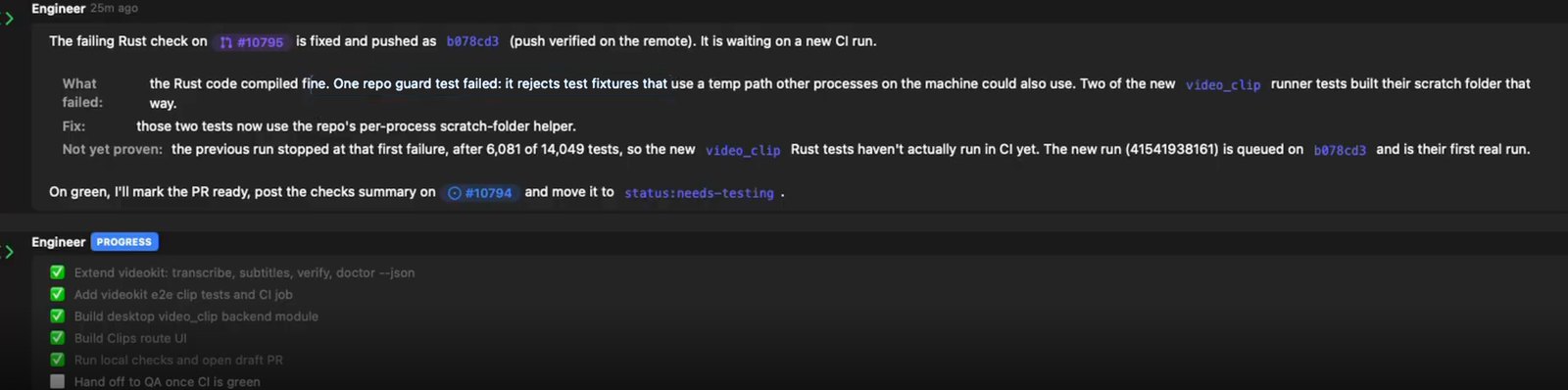
From our own project: what failed, the fix, and what's not yet proven, in one message.
A separate Tester checks the work, not the agent that wrote it, and posts a written QA report on the pull request. Operum won't merge a code change without a recorded approval from an agent that didn't write it. That's rule 3, and the details are in the rule 3 post.
You decide, and the decision is written down. When auto-merge is off, merges wait for your approval. When a decision is yours, the PM asks you and records your answer on the issue. In the example below, it also wrote down the risk I accepted.
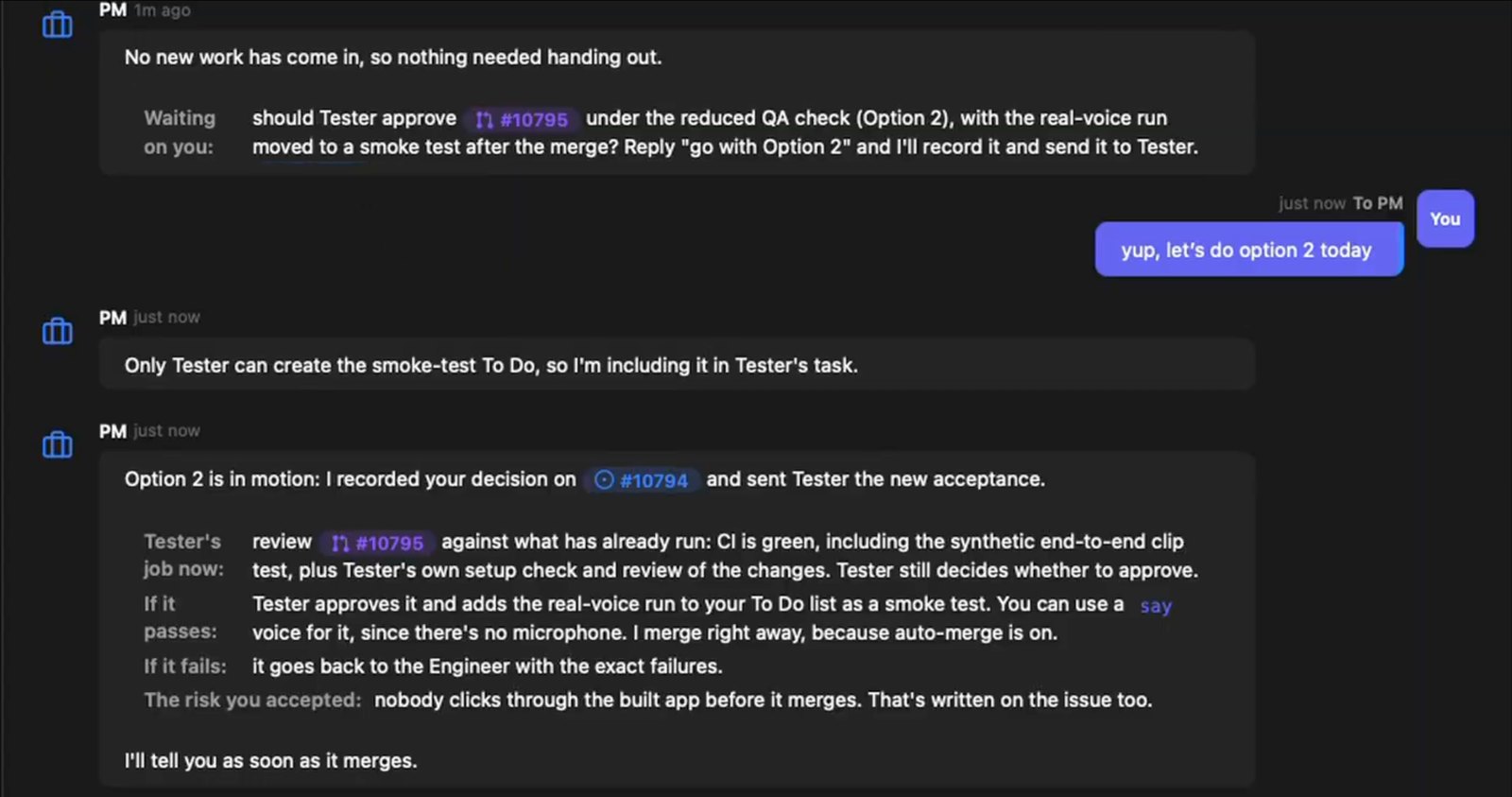
I chose a lighter QA check for one change. The PM wrote down my decision, and the risk I accepted, on the issue.
The reasons stay with the project. The issue keeps the plan, the review and the decisions, and every agent works from a shared knowledge base in your project. The next change starts from what was decided and why, not from a blank chat.
What Operum can't do is understand your business for you. It writes the "what" and the "why" down, and it asks you about the decisions that are yours. Reading those answers is still your part, and that's the point of this rule.
If you want to go deeper: the Workflow Board shows the stages each change goes through in the standard engineering workflow, from Architecture to QA Testing to Ready to Merge. For what CI and tests catch, and what they don't, read Five things I learned about safety, building with AI without a CS degree. Plans, including the Free plan, are on our pricing page.
The bug we fixed three times before we understood it
This happened on our own team, building Operum, in August 2026.
The Workflow page in Operum, the board where you see all the work, kept going blank or getting stuck. It was fixed. It came back. It was fixed again. On August 21, it was reported a third time.
Each fix had been correct as far as it went: each one stopped the page from getting stuck on "loading". None of them asked the question underneath: what should the page show when it has finished loading but has no data yet?
Our Architect stopped the patching and went looking for that answer in the code. It found it. When you switched between teams, the page reset itself into a state that looked exactly the same as "loaded, and there's genuinely no work". So it showed "No issues yet", even when there was plenty of work. And it found something more uncomfortable: an earlier rule, written by a previous Architect as a comment in the code, said never to do exactly this. A function 220 lines further down did it anyway. The Architect's summary: "The constraint was enforced by convention rather than by construction, so it leaked at the next call site."
In plain words: the rule existed, but only as a note. The next change didn't read the note, and two fixes were built on top without anyone understanding why the page kept going blank.
It also corrected our own count. The original issue had grouped seven bug reports as "the same problem". The Architect showed they had at least three different causes, and said the one fix would only solve one of them. Our PM wrote it down: "I wrote this parent implying one fix closes seven children. That is wrong, and the Architect said so explicitly rather than letting it stand."
How it ended
The Architect didn't ask for a third patch. It asked us to fix the whole kind of mistake, not just the one place it showed up, and that's what we built:
- "Still loading", "really empty" and "thrown away by a team switch" are now separate, named states on the board. "No issues yet" can only appear after a real answer from GitHub.
- The old rule moved out of the code comment and into the code itself. If someone adds a new state and doesn't handle it, the build fails.
- Tests go red if any loading or reset state could reach the empty screen.
- Our Tester didn't wave it through. It sent the fix back more than once before approving it, once for a branch of code that looked right but could never actually run.
That mistake is fixed for good: it can no longer reach the screen without the build or tests failing. Since then, we haven't seen another report of that same blank board. That doesn't mean the app can never show a blank screen for some other reason. Some of the original seven reports had different causes, and those needed their own fixes.
Why it matters for this rule: two patches treated the symptom, and the bug came back each time. What ended it was understanding the change: what the page should show, why it went wrong, and which rule had been ignored. Understanding took longer than a third patch would have. It was also the only thing that stopped a fourth.
That's the same loop every change goes through in Operum's standard engineering workflow. The Architect reviews the plan before anything is built. Here, that review is also what moved the rule out of a comment and into code. Then a separate Tester checks the result before it can merge.
What builders told us
In the conversations behind this series, builders kept describing the same thing: the trouble starts when changes pile up faster than anyone understands them.
- One builder said they never keep an agent session running for hours, because they don't want to review the change set that piles up, and in their experience the longer the session, the stranger the AI's mistakes get.
- One builder keeps a short notes file listing what the app does and what must not change, and pastes it at the start of every session.
- And in a Facebook group for Claude Code and OpenCode builders, I asked what slows people down once the AI has written the code. One member's answer included "technical debt". That's what this rule is about: decisions nobody understood, stacking up until they cost more to fix than to build.
The 14 golden rules of vibe coding
This post is part 4. One rule a day, in this order:
- Know why you're building, and who needs it.
- Define what "correct" means before asking for code.
- Ask for evidence before accepting "done."
- Understand each change before building more on top.
- Coordinate parallel work before it overlaps.
- Put safeguards in permissions and tools, not just the prompt.
- Plan the whole journey from your machine to a real user.
- Separate the maker from the checker.
- Stay in the loop: personally test the main user journey before accepting.
- Ask questions and challenge decisions.
- Add CI as your product grows.
- Give your project a memory outside the chat.
- Watch how it's actually used once it ships.
- Make safety a gate, not a hope.
Next: coordinating parallel work before it overlaps.
The next time the AI finishes a change, before you ask for the next one, ask it one question: what did you decide on my behalf?
And a question for you: what's a change you built on that turned out to rest on something you never agreed to?
FAQ: understanding AI code changes before you build on them
What is the fourth golden rule of vibe coding?
Understand each change before building more on top. Before you accept an AI change and build the next thing on it, make sure you can say what exactly changed, why it was needed, what else it could affect, and how you know it works. It is rule 4 of the 14 golden rules of vibe coding by Olga Primak, co-founder of Operum.
Do I need to read every line of AI-generated code?
No. You need to understand the change, not every line. Addy Osmani writes that "Reading every line was never what made software trustworthy," and that you should be able to explain what a change does, what it touches and why it's safe to ship, because "You can only really be accountable for what you can explain."
How do I understand AI-generated code if I can't code?
Ask the AI to explain the change in plain language, as a customer would notice it, and to list the files it touched. Then answer four questions in your own words: what changed, why, what else it could affect, and how you know it works. If you can't explain it back in two sentences, don't build on it yet.
Why does AI fix one bug and create three others?
Often because the first fix rested on an assumption nobody checked, and each later fix was built on top of it. AI coding agents also copy the patterns already in your project, so an unnoticed shortcut gets repeated. Understanding each change before the next one stops the guesses from stacking up.
Should I accept all AI code changes without reading them?
Only for throwaway projects. Andrej Karpathy, who coined "vibe coding", described accepting everything without reading the diffs, but framed it for throwaway weekend projects. For software people rely on, every accepted change becomes the foundation for the next one, so understand it first.
How big should each AI code change be?
Small enough to explain in two sentences and undo in one step. Save each change as its own version (commit), keep sessions short, and if a fix needs a third attempt in one session, go back to the last working version instead of fixing on top of a fix.
How do I avoid technical debt when vibe coding?
Understand and record the decisions as you go. Ask the AI what it decided on your behalf, check each change against a short "must not change" list, and keep a change diary of what changed, why and in which version. Debt grows fastest when changes are built on decisions nobody understood.
What is the difference between rule 3 and rule 4?
Rule 3, ask for evidence before accepting "done", checks that a change works. Rule 4 checks that you understand what you accepted: what it changed, why, and what it decided for you. A change can pass every test and still carry a decision you'd never have made.
How much should I review each AI change?
In proportion to risk. Addy Osmani's rule is "Tier by risk, not by author": a label or color change needs a glance, while anything touching sign-in, payments or user data deserves the four questions every time.
How does Operum help me understand each change?
In Operum's standard engineering workflow, every change starts as an issue with a stated purpose and a "done" list that the Architect reviews before code is written, and by default one issue becomes one pull request linked to that issue. Agents say what they haven't proven yet, a separate Tester posts a written QA report, and decisions that are yours are asked of you and recorded on the issue.
What are the 14 golden rules of vibe coding?
They are a 14-part series by Olga Primak, co-founder of Operum, published one rule a day starting in November 2026. Rule 1 is "Know why you're building, and who needs it." Rule 2 is "Define what 'correct' means before asking for code." Rule 3 is "Ask for evidence before accepting 'done.'" Rule 4 is "Understand each change before building more on top." The full list is in the section above.
Sources
All read on November 25, 2026.
- Addy Osmani, The Code Nobody Reads, September 28, 2026
- Addy Osmani, Code Review in the Age of AI, January 5, 2026
- Addy Osmani, Agentic Code Review, June 16, 2026
- Simon Willison, A quote from Andrej Karpathy, simonwillison.net, February 6, 2025
- Simon Willison, My fireside chat about agentic engineering at the Pragmatic Summit, simonwillison.net, March 14, 2026
- Simon Willison, Anti-patterns: things to avoid, Agentic Engineering Patterns
- GitHub Docs, Review AI-generated code


